

Rising Damp vs Penetrating Damp: How to Tell the Difference
Rising damp climbs from the ground with a tide mark, while penetrating damp enters sideways from an external fault. Here is how to tell them apart.
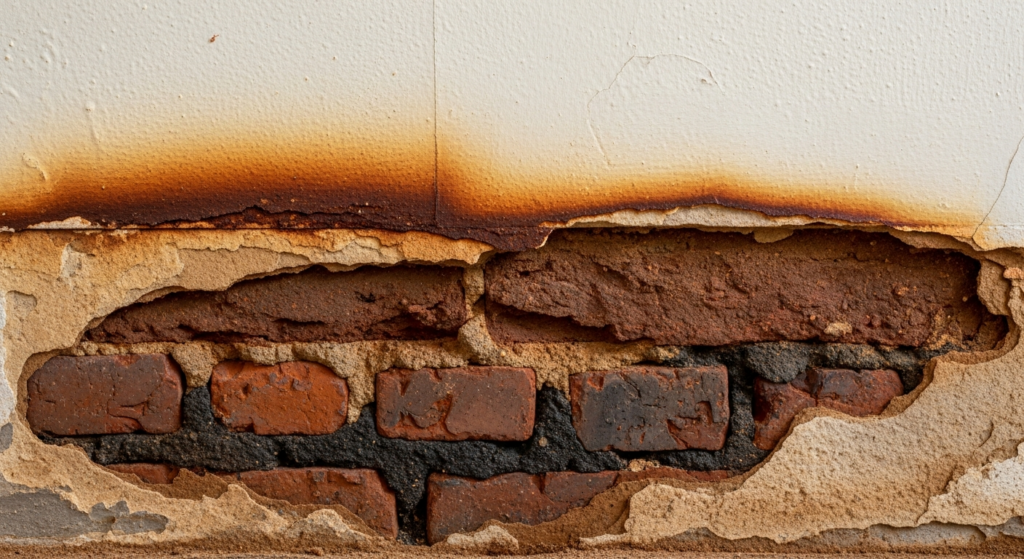
Telling these two apart matters because the cure is completely different. Treat penetrating damp as rising damp and you spend money on the wrong wall while the real fault keeps soaking your home. Below is how to read the evidence yourself, and when to bring in a surveyor.
What is rising damp and how do I recognise it?
Rising damp is groundwater drawn up through porous masonry by capillary action, almost always affecting ground-floor walls only. It appears when a damp-proof course is missing, bridged or has failed. The classic signature is a horizontal tide mark that stops around 1 metre above floor level, because water cannot climb much higher.
Watch for these signs:
- A clear horizontal tide line low on the wall
- White, fluffy salt deposits (efflorescence) on plaster or brick
- Skirting boards, plaster and wallpaper lifting near the floor
- Damp that is present all year, not just after rain
- Affects ground-floor walls only, never upstairs
What is penetrating damp and how is it different?
Penetrating damp is water entering horizontally or downward through a defect in the building fabric, so it can strike at any height and on any floor. Unlike rising damp, it is tied to a specific external fault and a specific patch of wall rather than a continuous line along the ground floor.
Tell-tale signs include:
- Isolated damp patches that darken noticeably after rain
- Staining at any height, including upper floors and ceilings
- Patches near gutters, downpipes, window frames or roof junctions
- Brown or tea-coloured stains rather than a salt tide mark
- Damp that dries out during long dry spells
Could it actually be condensation instead?
Yes, and this is the most common misdiagnosis of all, because condensation mimics both. Condensation forms when warm, moist air meets cold surfaces, so it gathers in corners, behind furniture, around windows and in bathrooms and kitchens. The giveaway is black spotty mould rather than a tide mark or rain-linked patch, plus streaming windows in the morning. Because the three causes overlap, a wrong guess wastes money, which is exactly why a proper diagnosis pays for itself.
Not sure what you're dealing with?
Send us a photo on WhatsApp. We'll tell you what it is, no charge, no obligation.
How do I diagnose the difference step by step?
Work through the wall methodically before assuming the cause. Follow this order:
- Note the height of the damp. Capped near 1 metre on a ground floor points to rising damp.
- Check whether the patch is localised or runs along the whole wall base.
- Watch the wall after heavy rain. A clear link to rainfall points to penetrating damp.
- Look outside for a cause directly behind the patch, such as a cracked render, leaking gutter or perished pointing.
- Inspect for black mould in cold corners, which suggests condensation.
- If the evidence is mixed or you cannot reach the source, book a professional survey.
A surveyor confirms the cause with moisture readings, salt analysis and a fabric inspection, then sets out the correct remedy. Our Damp, Mould and Water Damage Assessment does exactly this and leaves you with documented proof rather than guesswork. Where a hidden pipe or roof fault is suspected, our leak detection service traces the water to its source.
What does it cost to diagnose and fix damp?
We confirm the price on a written quote once we understand the problem. That includes an insurance-ready written report with a photographic evidence appendix, so you have something solid for an insurer, landlord or solicitor. It is the only fixed price we publish, because diagnosis is standard but repairs never are.
Remedial and treatment work is always quote based, because no two damp problems are identical. The process is simple: you send a video of the whole affected room, we assess it, and we provide a fixed-price quote for the work needed. Approved works are paid 50 percent upfront and 50 percent on completion. Emergency or out-of-hours work carries an additional cost, which we make clear before any visit.
Who is responsible if I rent the property?
If you rent, damp caused by the building fabric is generally the landlord’s responsibility to investigate and fix. Under Awaab’s Law and the Renters’ Rights Act, landlords face firm duties to address damp and mould hazards within set timeframes rather than blaming tenant behaviour. A dated survey report with photographic evidence gives tenants the documentation to compel action and gives landlords the proof they have acted properly. Our written report is built for exactly this purpose.
Arrange your Damp, Mould and Water Damage Assessment with Damp & Mould Solutions UK
Damp & Mould Solutions UK diagnoses and resolves rising damp, penetrating damp and condensation across the UK, including London boroughs such as Camden, Islington, Hackney, Lambeth, Southwark, Wandsworth, Croydon and the surrounding boroughs. Call us on 020 3051 8478 to discuss your problem, or send photos and a short video of the affected room via WhatsApp and we will guide you on the next step.
Frequently Asked Questions
Can rising damp appear upstairs?
Does the patch getting wet after rain mean penetrating damp?
How much is a Damp, Mould and Water Damage Assessment?
How do you price the actual repair work?
Is my landlord responsible for damp?
If you've got damp, mould, or a leak, you already know it needs sorting.
The longer it sits, the worse it gets. Get in touch and we will agree a date with you. If it is urgent, say so when you call.