

Heating Leak Detection: How Hidden Central Heating Leaks Are Traced
How hidden central heating leaks are traced with acoustic, thermal and tracer gas methods, what affects the cost, and what happens once the leak is found.
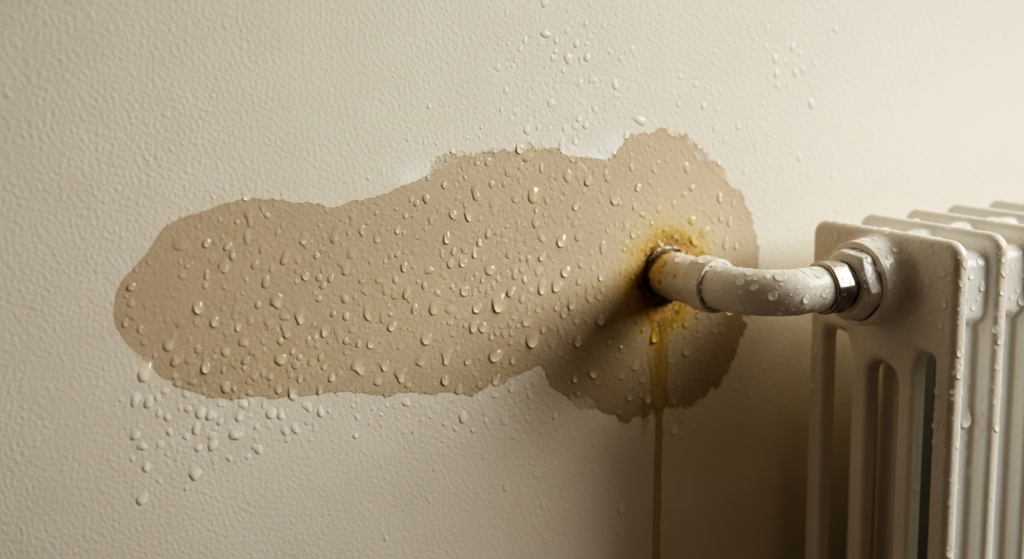
What causes a hidden central heating leak?
Hidden central heating leaks usually start at buried pipework, failed compression joints, corroded copper or pinholes in pipes running under screed, timber floors or behind plaster. Older systems with mixed metals corrode from the inside, while newer underfloor heating can fail at manifold connections or where pipes were nicked during another trade’s work. Pressure changes, sludge build-up and thermal expansion all accelerate the problem. Because the pipe is concealed, water tracks along joists or through screed and surfaces well away from the actual fault, which is why guessing where to lift floors so often misses the source.
What are the signs of a heating leak in my home?
The clearest sign of a heating system leak is a boiler that keeps losing pressure and needs topping up, often paired with damp patches that appear when the heating is on. Watch for these symptoms:
- Boiler pressure dropping below 1 bar and needing repeated re-pressurising
- Warm or damp patches on floors, skirting or ceilings that worsen with the heating running
- The sound of running or trickling water when radiators are off
- Cold spots on radiators or floors despite the system being on
- A persistent musty smell, lifting laminate, or staining around pipe runs
- Unexplained rise in water usage or the heating cycling more than usual
How is a heating leak actually traced?
A heating leak is traced by combining several non-destructive techniques so the exact point is confirmed before anything is lifted or opened. A typical investigation follows this sequence:
- System assessment: we check boiler pressure behaviour, isolate sections and confirm the leak is on the heating circuit, not plumbing or rainwater.
- Thermal imaging: a thermal camera maps warm pipe runs and reveals temperature anomalies where heated water is escaping.
- Acoustic detection: sensitive listening equipment picks up the sound of water escaping under pressure through floors and walls.
- Tracer gas: for the most stubborn faults, a safe hydrogen tracer gas is introduced and detected at the surface, pinpointing the leak to within centimetres.
- Marked location and report: the exact spot is marked up and recorded in a clear written report.
This layered approach means we locate the fault precisely rather than lifting whole floors on a hunch. You can read more about our wider leak detection service and how we approach concealed water issues.
Not sure what you're dealing with?
Send us a photo on WhatsApp. We'll tell you what it is, no charge, no obligation.
What affects the cost of heating leak detection?
The cost depends on the size of the property, how much of the pipework is concealed and which methods are needed to confirm the leak. We confirm the price on a written quote once we understand the problem, and we will agree a date with you. If it is urgent, call us on 020 3051 8478. The value lies in precision: by locating the leak non-destructively with acoustic, thermal and tracer gas methods, and supplying a written report, your repair work is targeted to one spot. That avoids the cost and disruption of opening floors and walls speculatively, which usually costs far more than the detection itself.
What happens after the leak is found?
Once the leak is located and marked, the repair becomes a focused job at a single known point rather than exploratory demolition. Our written report gives your plumber or heating engineer the exact location, depth and nature of the fault, so they can expose, repair and reinstate with minimal disruption. Where water has already saturated screed, subfloor timber or plaster, the affected area will need drying out properly to prevent lasting damp and mould. We provide structural drying to remove that trapped moisture with controlled equipment and monitoring, returning the building fabric to a stable moisture level before any redecoration.
Is heating leak detection different from a Damp, Mould and Water Damage Assessment?
Yes, heating leak detection is a separate, specialist service focused on physically locating a live leak in your central heating pipework, not a general Damp, Mould and Water Damage Assessment (what many people call a damp survey). An assessment diagnoses why a building is damp across a range of possible causes, whereas leak detection uses acoustic, thermal and tracer gas equipment to pin a specific escaping pipe to an exact location. If your boiler keeps losing pressure or a wet patch tracks with the heating, leak detection is the targeted investigation you need, and it is priced and carried out as its own job.
Arrange heating leak detection
Damp & Mould Solutions UK provides professional heating leak detection for homes and businesses across the UK. If your boiler keeps losing pressure or damp keeps returning when the heating is on, call us on 020 3051 8478 or send photos via WhatsApp for an initial view of your situation. We will explain the likely cause, the detection methods suited to your property and the next steps towards a precise, targeted repair.
Frequently Asked Questions
How much does heating leak detection cost?
Can a heating leak be found without lifting the floor?
Why does my boiler keep losing pressure?
Is heating leak detection the same as a Damp, Mould and Water Damage Assessment?
What happens after the leak is located?
If you've got damp, mould, or a leak, you already know it needs sorting.
The longer it sits, the worse it gets. Get in touch and we will agree a date with you. If it is urgent, say so when you call.